- Outline Drawings Of People's Bodies
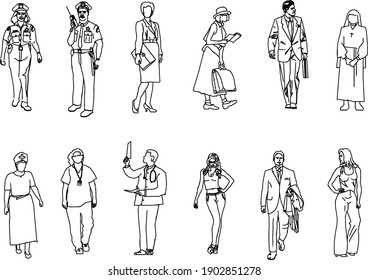
- Outline Sketches Of People
- Outline Drawings Of Famous People
- People Clip Art Outline
The following outline is provided as an overview of and typical guide to drawing and drawings:
- To draw realistic people, start by making a circle and bisecting it with a vertical line. Next, add horizontal guides for the eyes, nose, mouth, and the outline of the jaw and chin. Then, make neat shapes for the eyes on the horizontal line and a realistic nose on the vertical line, below which you can add a pair of lips.
- Drawing Professor's team of fine arts professionals and design specialists have developed the ultimate tool for learning how to draw people online; a comprehensive drawing course comprised of 14 multimedia drawing lessons, each with practical exercises, quizzes and assignments. As of student of Drawing Professor, you will have access to.
Sep 01, 2020 How people see the world is reflected in their eyes (Image credit: Veri Apriyatno) Indonesian artist Veri Apriyatno explores the human form and emotion through his hyper-realistic pencil drawings. This series, entitled Witnesses, presents how people feel about the world through the reflection in their eyes, drawn in pencil, acrylic and charcoal.
- Drawing – activity of making marks on a surface so as to create some images, form or shape.
- A drawing – product of that activity.
What types of things are drawing and drawings?[edit]
- Drawing is a type of:
- Activity – something someone does
- Art – an art, one of the arts, is a creative endeavor or discipline.
- Visual art –
- Avocation –
- Vocation –
- A drawing is a type of:
- Art –
- Work of art –
- Illustration dash;
- Work of art –
- Art –
Outline Drawings Of People's Bodies
Types of drawing and drawings[edit]
Story telling[edit]
- Anime –
- Comics –
- Cartoons –
- Manga –
Non - story telling[edit]
- Academy figure –
- Caricature – pictorial representation of someone in which distinguishing features are exaggerated for comic effect.
- Fashion illustration –
- Figure drawing –
- Gesture drawing –
- Line art – images that consist of distinct straight and curved lines placed against a (usually plain) background, without gradations in shade (darkness) or hue (color).
- Portrait –
- Scratchboard –
- Silhouette –
- Silverpoint –
- Sketch –
- Courtroom sketch –
- Croquis –
- Doodle –
- Multi-Sketch –
- Study –
- Scribble –
- Stick figure –
- Technical drawing/technical illustration –
- Architectural drawing –
- Electrical drawing –
- Engineering drawing –
- Plumbing drawing –
- Structural drawing –
- Scientific illustration (in natural sciences, also referred to biologic, zoologic, or botanical illustration)
- Mechanical systems drawing–
- Working drawing–
- Archaeological illustration–
Drawing techniques[edit]
- Automatic drawing –
- Blind contour drawing – this action is performed were the artist looks at the object and does not look at the canvas or sketch pad
- Contour drawing –
- Chiaroscuro – using strong contrasts between light and dark to achieve a sense of volume in modeling three-dimensional objects such as the human body.
- Gesture Drawing - loose drawing or sketching with the wrists moving, to create a sense of naturalism of the line or shape, as opposed to geometric or mechanical drawing
- Grisaille –
- Hatching – consists of hatching, contour hatching, and double contour hatching
- Masking –
- Mass drawing –
- Screentone –————″″
- Scribble –
- Stippling – using tiny dots that become closer to create darker values, and gradually further away to create lighter values
- Trois crayons – using three colors, typically black, white and sanguine chalks
- Drybrush –
Outline Sketches Of People
Types of draughtsman[edit]
Draughtsman or draftsman –
- Cartoonist –
- Drafter –
Drawing media and equipment[edit]
A medium (plural: media) is a material used by an artist to create a work.
Common drawing types[edit]
- Pastel –
- Oil pastel –
- Charcoal –
- Colored pencil –
- Conté –
- Crayon –
- Graphite – can be pencils which are small or large sticks similar to charcoal
- Marker –
- Pen and Ink –
- India ink –
- Technical pen –
- Sanguine –
Common bases for drawing[edit]
- Canvas –
- Paper – most common base for drawing.
- Sketchbook –
- Tracing paper –
- Plaster –
- Metal –
- Walls – typically for murals.
- Wood –
Other drawing equipment[edit]
- Compass –
- Eraser –
- Kneaded eraser –
- Drawing board –
- Fixative –
- French curve –
- Protractor –
- Ruler –
- Rolling ruler –
- Stencil –
- Stump –
Principles and elements of drawing[edit]
- Composition –
- Elements of art – group of aspects of a work of art used in teaching and analysis, in combination with the principles of art. They are texture, form, line, color, value, and shape.
- Perspective – the principle of creating the illusion of 3-dimensionality on a 2-dimensional source such as paper. This is achieved by using one or more vanishing points (Line perspective), or making the atmosphere greyer, blurrier and smaller as it goes further back (Atmospheric perspective).
- Principles of art – set of guidelines of art to be considered concerning the impact of a piece of artwork, in combination with the elements of art.[1][2] They are movement, unity, harmony, variety, balance, emphasis, contrast, proportion, and pattern.
Drawing education[edit]
- Atelier –
- Art school –
- Life class – Observational drawing from a real life model, usually a nude model.
- Magnet Art school programs -
Awards[edit]
- Payout Jerwood Drawing Prize –
Organizations[edit]

History of drawing[edit]
- Lineography –
- Plumbago drawing –
Some notable draftsmen and drawings[edit]
- Leonardo da Vinci (1452–1519) – Focus' on human anatomy and life forms.
- Vitruvian Man (c. 1487) –
- Albrecht Dürer (1471–1528) –
- Betende Hände ('Praying Hands', c. 1508) –
- Michelangelo (1475–1564) –
- Epifania –
- Hans Holbein the Younger (c. 1498 - 1543) –
- Peter Paul Rubens (1577–1640) –
- Isabella Brant (c. 1621) –
- Jean de Beaugrand (1584–1640) –
- Aubrey Beardsley –
- Jacques-Louis David –
- Pierre-Paul Prud'hon –
- Edgar Degas –
- Théodore Géricault –
- Francisco Goya –
- Jean Ingres –
- Odilon Redon –
- Henri de Toulouse-Lautrec –
- Honoré Daumier –
- Vincent van Gogh –
- Käthe Kollwitz –
- Max Beckmann –
- Jean Dubuffet –
- Egon Schiele –
- Arshile Gorky –
- Paul Klee –
- Oscar Kokoschka –
- Alphonse Mucha –
- Gustave Doré (1832–1883 – )
- Edward Linley Sambourne (1844–1910) –
- The Rhodes Colossus (1892) –
- M. C. Escher (1898–1972) –
- Metamorphosis I (1937) –
- Metamorphosis II (1940) –
- Reptiles (1943) –
- Drawing Hands (1948) –
- Relativity (1953) –
- Ascending and Descending (1960) –
- Waterfall (1961) –
- Metamorphosis III (1968) –
- André Masson (1896–1987) –
- Jules Pascin (1885–1930) –
- Pablo Picasso (1881–1973) –
- Don Quixote (1955) –
- Jorge Melício (1957- ) –
- Erotic Feelings (series) –
- Drawings by Douglas Hamilton –
See also[edit]
References[edit]
- ^'Definition from Sanford'. Archived from the original on 2008-08-20. Retrieved 2010-11-17.
- ^'Principles of Art' Utah Education Network
Outline Drawings Of Famous People
External links[edit]
People Clip Art Outline
Retrieved from 'https://en.wikipedia.org/w/index.php?title=Outline_of_drawing_and_drawings&oldid=1028506192'